
Does Pop Culture Still Exist?
Triviality Isn't Trivial

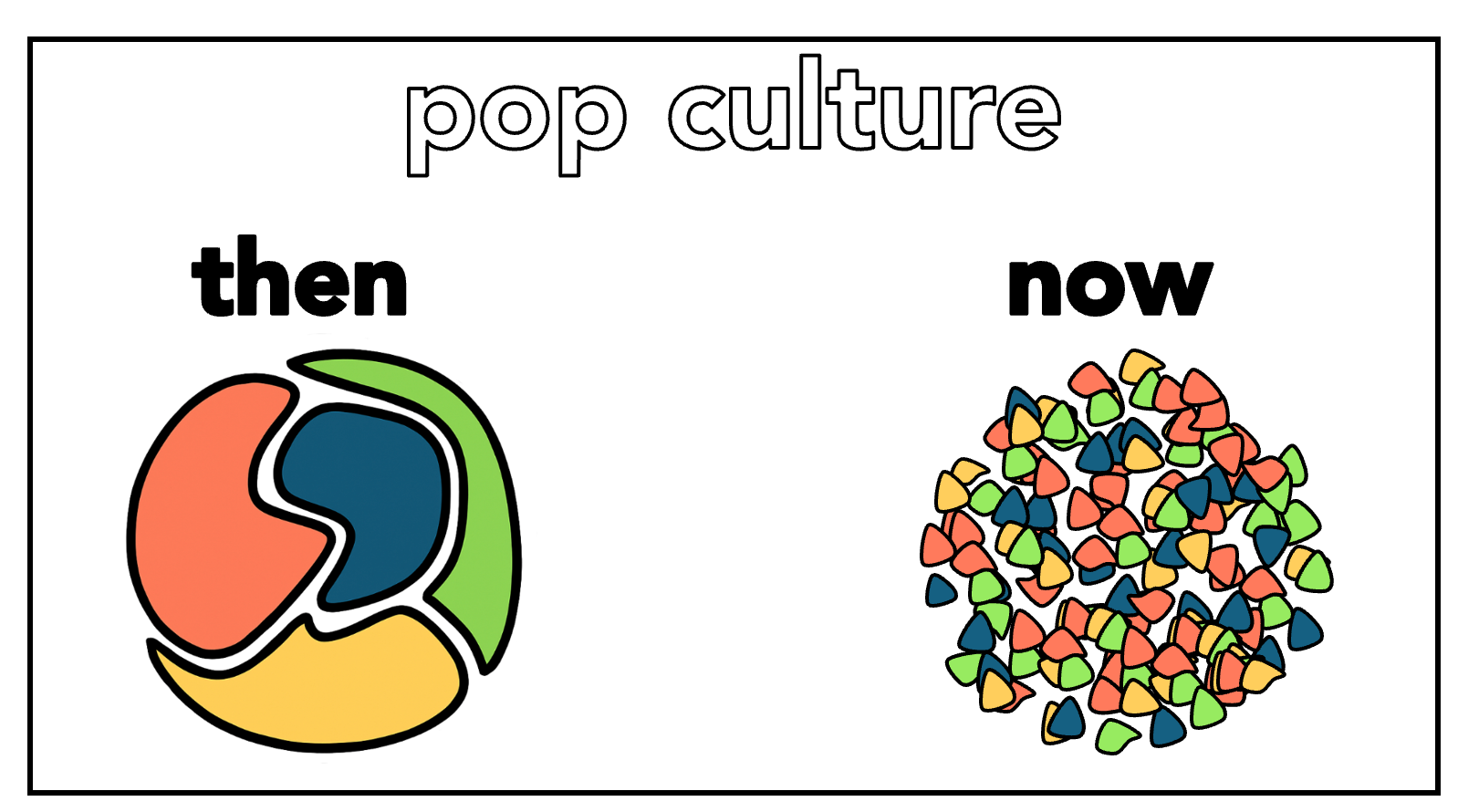
Pop culture sounds like an old idea, an idea of the 20th century, specifically, when a small set of movie studios, TV channels, and record companies were responsible for putting out much of the culture we consumed. This was the era of pop culture as monoculture, a cultural milieu in which everyone watched, listened to, and talked about the same stuff.
The anxieties of the day had to do with pop culture’s vulgarity, which was both what distinguished it from so-called high culture and what made it cause for parental concern. In some corner of the discourse, there was always a discussion, and the concomitant handwringing and pearl clutching, about what the youth were doing with pop culture (mimicking it) and what pop culture was doing to the youth (corrupting them).
So, yes, pop culture still exists. It has, however, taken new form. The overwhelming sweep of new technologies across the past two decades—camera phones, social media, now AI—shattered pop culture into millions of infinitesimally tiny fragments. This is figuratively, but also literally, true as social media users grind down bigger works like films, TV shows, and songs into 15-second units of content fit for the algorithmic feed.
Pop culture still exists, and we should keep working to pay attention to it. But note: it does take work. It takes effort to get a good look at particles that small. It would be reasonable to assume that it’s not worth it, that culture today is too ephemeral, too trivial (what, did someone here devote three whole pages of a book to a Baby Yoda meme from 2019?) to warrant the effort.
But triviality isn’t trivial. The fact is that pop culture is now not just harder than ever to examine. It is also, by the same mechanics, more pervasive than ever. We used to pick culture up, hold it in our hands, regard it. Now, we breathe it. Like dust particles, bits of culture have settled in the crevices of our minds and lives. It is, simply, everywhere.
And so today, we inhabit a monoculture of a different sort. There’s no one set of TV shows, films, and albums we’re all consuming, that we can all discuss around the proverbial water cooler. But we all do the same stuff: the endless scrolling, the double-tapping, the pressing-to-skim, the second-screening. Ours is not a monoculture of content but one of practices.